談山神社

談山神社

2.18.2014

The world of the monochrome

There was the heaviest snowfall in many years around Nara district.
After waking up and open the window I discovered so white snow world outside. It's very beautiful, quiet morning. Then I got a call from a friend that it's a good chance to take  snow views today.
As it's so cold I was reluctant to go outside but that  call encouraged me to go outside.

At the entrance, I hesitated which boot I should put on. I don't have long snow boot. Because we rarely have snow in Nara area. So I put on mountain-climbing boots.

While I was walking to the station, traffic was blocked with a stalled truck on a snow slope. A patrol car was crying to another cars "U-turn". I thought u-turn is tough work on the snow slope. Many cars didn't take snow-tires or chain. Very dangerous. Drivers aren't used to  the snow road.
A commuting bus also had an accident and many commuters had to walk about 2kilometers to the station.
At the station, trains had 18minutes' delay. The announce said " Due to snow, trains run slowly." Japanese trains usually seldom delay but it's no wonder today.

Heavy snow and water of thawing snow soaked  my shoes soon in Nara park.

                                                  Kofukuji-temple ,five-storied pagoda


                                                        Ukimi-do


                                                 Sarusawa-pond


                                              Kofukuji-temple, hakakudo


                                          The approach to kasuga-grand-shrine


                            Deers eat leaves. So trees around here are trimmed at the level of  deer's height.


                                                           Kasuga-shrine


The view seemed like monochrome painting. Black and white and stillness. The snow is only accumulating with no sound. This was a monochrome world like a Japanese ink wash painting.
Japanese ink wash painting flourished in 室町時代(Muromachi-era,1392~1573). As the Ashikaga-Shogun in Muromachi-era protected Zen, Zen culture thrived and influenced on monks who drew the ink wash painting like 雪舟(Sesyu). They depicted actual view or mountain landscape in Japan with the original way.

                                                                 Japanese ink wash painting by 雪舟


          Thank you for visiting. Have a lovely day!

2.06.2014

The first day of spring


節分万灯篭(setubun-mantoro)------節分means time when seasons change and especially the day before the beginning of spring. 万灯篭means many lanterns.
This event has been holding from about eight hundreds years ago. About 3000 lanterns are lit at Kasuga-Grand-Shrine on the nights of 節分(setubun, on February 3rd) and お盆(obon, on August,14th and 15th).


From old days , offering light for divine has the same meaning to pray with offerings. We devote, moving our cordiality to light,I heard.

Kasuga-Grand-Shrine enshrine the Davine of Fujiwara clan originally. This event was started by donation of lanterns from Fujiwara-clan in Heian period of 8~9century.


There are a lot of stone-lanterns in the precinct.


Each of the patterns made by the metal outside lanterns is different because many people devoted their own original ones. There are many lanterns decorated with its heraldry or has the  name of contributors with kanji character.
This lantern was devoted by 直江兼続(he is a famous samurai in 16-17century and his armor helmet has the big character "love (愛)" in front of it.)He devoted this by his daughter's name 松。


Many stone lanterns to the approach to the shrine were lit on the night .


The next day of this event is the first day of Spring,according to the calendar. But it's pretty cold today.


                                           ~~~~~~~~~~~~~~~~~~


Birds came in our winter garden. My husband hung a can put fruits fragment from the branch at the near window of the dining room. So we can enjoy their figures through the window,having meals.

A white -eye are eating a persimmon that a bulbul dropped.

I am surprised his appetite. They come to here many times a day and eat greedily and drop many food. They got here as their territory.

I don't know this bird's name. It's too yellow for a sparrow.


This bird's favorite is  banana, I wonder. But this is too small for banana.

Other four kinds of birds come but their motion is too fast to take photo for me.


                                         Thank you for visiting, Dear  friends!


1.16.2014

The event for good luck


                              I wish you happiness in 2014, my dear friends!


I visited two auspicious events at the beginning of the year.

The first,
Osaka district is a center of commerce. So many merchants or businesspeople especially visit Ebisu-Shrine to get good luck, fortune on the 10th of January.
Ebisu-Shrines enshrine God Ebisu.
God ebisu is one of seven gods in Japan and have a fishing rod in the right hands, holding a big sea bream under the left arm. This god was a god of fishing in the old days. But after commerce started developing in the Middle Ages people began to believe as god of prosperity of business,too.

I visited Saraki-Shrine in Nara district that enshrine God Ebisu.


These women are called Fuku-Musume(Fuku means good luck, Musume means girl) and they attach ornaments to a small bamboo and shake bells to call happiness for visitor. In this shrine, they usually work for a big company but they volunteer on this day. How beautiful today's Fuku-Musumes are!


The second,
舞楽始式(The first dance of the year) in Kasuga-Grand-Shrine.

The dances came from the Asian Continent in 7or 8 century and Japan own dances have being preserved. This tradition were handed down three organizations where  are in Kyoto district,Nara district,Osaka district.
Today's dance was dedicated by Nara's organization.


        胡飲酒(konjyu) The king of the country of Hu dances intoxicated to alcohol, I heard.


   振鉾三節(enbu-sansetu) dance for praying that people live in security, 三節means honoring the heaven, the earth, the spirit ,I heard.


       長保楽(chobouraku)


                                      Thank you for coming.


12.25.2013

On-maturi

This is Wakamiya- Shrine's festival. Wakamiya-shrine is affiliated with Kasuga-Grand-Shrine.

In the year 1136, people in Yamato district were suffering from flood or hunger, so Kanpaku(the rank to assist a Emperor)-Fujiwarano Tadamichi built the temporary palace and dedicated performing arts to Wakamiya God.  Rain stopped and became to get rich harvest. So this became an annual event. This festival has been continued and this year is the 878th.

                                   Yabusame by a boy.    He put an arrow in the target excellently


                                                   Maiden in Shrine


                                                          Bacyo-no-chigo


                                                              before the parade


                                                  Daimyo-gyoretu


                                                                      horse race


The festival was held from the 15th to the 18th on December. The climax is the 17th. At 0:00a.m. Wakamiya God enter at the temporary palace.  From 12:00p.m. performing arts groups and people join the festival start a procession. From 3:30p.m. until 11:00p.m. they dedicate dances on the 9 m square grass stage. After those performing Wakamiya God get back to his usual palace around 11:30p.m.

                                                           They played Kagura
 

                                            Azuma-asobi   four boys played.


                                                                         Dengaku


                                                                     Seinoo


Since Onmaturi began in Nara where Japanese culture was born.  Shinto ritual  or Kagura, Azumaasobi, Yamatomai etc in old Japanese performing arts have been strictly protected .Bugaku that came from Korean peninsula are handed down. And Dengaku, Seinoo, Sarugaku etc that were formed among citizen in Middle Ages are succeeded relatively correctly. So this festival look like the museum of art performance.

    Bugaku,  Kitoku  (I took last year.If you would like to see last bolg, click Here .)


                                                                                                ( I took the year before last)


                                                                         Bugaku,  Nasori            (I took last year)


Thank you for visiting during this year.
Wishing you Merry Christmas and Very Happy New year!              
                                                                              Best Wishes Sarah


12.04.2013

Today's Todaiji-Temple

Today I felt here is alive with foreign travelers,having a bustle before the  Lehman Shock. Thanks to yen's depreciation,I wonder?

I walked around at the site of the Todaiji-Temple today.
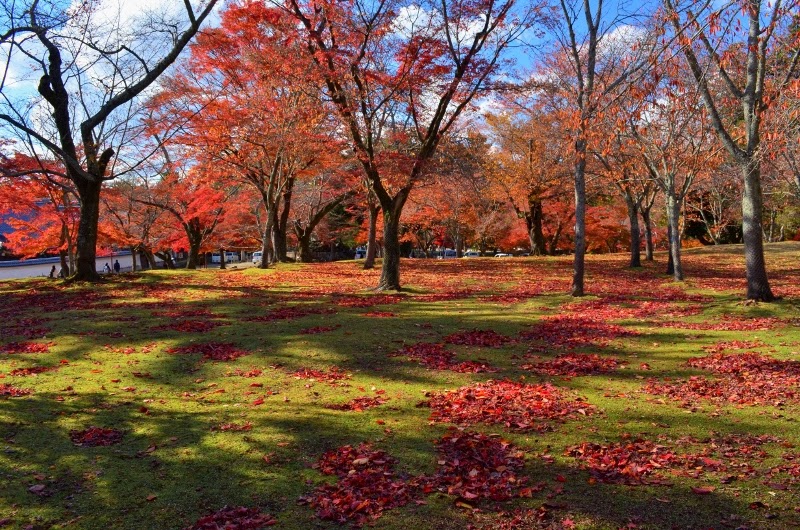
Maples or ginkgos leaves have already colored and started falling from the trees. they were showing the last glow, receiving the late autumn's light.


As the site of Todaiji-Temple is very large and I don't know well about the way around there. So I strolled the place where I can see the golden しび( a kind of decoration that attached the both side of ridge of roof,  charm against the fire, that's embodied the shape that fish jumps from the surface and left its tail over the surface.)
             
                                                      The Great Buddha of Todaiji


                                                                 Around Daibutu Pond


                                                    From The Febuary -Hall in Todaiji


There are many big ginkgo trees in the site and  their golden leaves were strewed and accumulated widely around them. The place covered with ginkgo's leaves are shiny in the dimly grove, so couples, children, foreign travelers and deers were exciting together on the yellow carpet and  touching the warmness ginkgo provided.


When Fall turned the leaves crimson in Japan, people go maple viewing. This custom started around Heian period ( around 8 ~12century, its capital was Kyoto city) so many maple trees are planted in Kyoto city.

Many people composed a tanka poem related to the maple trees. This was composed in around 10 century.

                奥山に紅葉踏み分け
                     鳴く鹿の 
                          声聞く時ぞ秋は悲しき

meaning:
  Feet deep in maple's autumnal carpets in the mountains,

     Away from crowds along with distant voice,

      Heart deep in sorrow with deer crying in solo.


(Both the writer and the deer were disappointed in love,I wonder?)


Some world heritage site like Todaiji-temple or Kasuga Grand Shrine or Kofukuji-Temple etc, are built near each other and also adjoin the living space of people or Nara park. We can go around by foot. People are trying to let the living space sit in the situation of the old days as possible as they can. So when I walk there I can be in the restful world like time stopped. I like it. I think it's similar to some  European medieval world heritage site.