談山神社

談山神社

6.20.2013

Barcelona in enchanting Spain

I went over Mt.Pyrenees this time for the first time. There was the blue sea, the shining sun and the curvilinear architectures in Barcelona. Because the movement for art revival  happened in Catalunya in 19~20century and the fusion style of Islam art and Gothic art developed in the architecture field.

 Basilica of Sagrada Familia was soaring in the blue sky at Barcelona. It seemed to be made by brown soil and very complicated structure. I've never seen such church like this shape.
Sagrada Familia means The Holy Family(Jesus, Virgin Mary,Saint Joseph),according to a book.


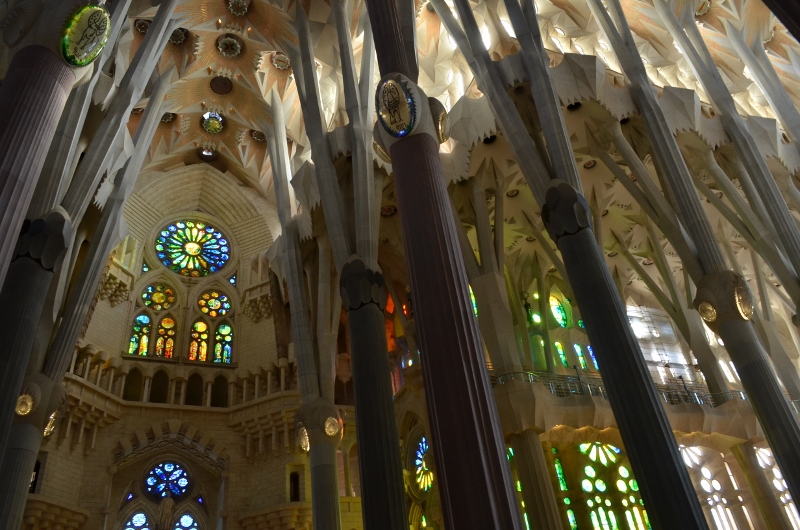
The atmosphere of the inside differed from its outside completely.
Many big white pillars that fork at upper part hold the ceiling and soft green or golden lights from the stained glass flow to inside. How beautiful!
The inside was bright ,not like common churches. I felt that I was in the bright forest and I also felt I was in the another world.
Each design had  highly originality as I've never seen.  Antonio Gaudi is really a genius.

When my children visited there about ten years ago, the inside was under construction and many instruments were laid on the floor, according to them. Yes, this church is not still completed. As it is approaching to completion every day little by little, it may be interesting to visit there to see a newly produced part after some years. According to a brochure, it is planed  to have 18 spires. Wow, so gorgeous!


                   Inside of the basilica


As I found figures look like characters in the movies on one facade, I was surprised again. This facade is called "Facade of Passion". They say this express the passion,death and revival of Jesus and by abstracting figures on this facade, internal world are represented.

At the opposite entrance, there was a facade is called " Facade of Birth". This  expresses that all bless the birth of Jesus and a story of Holy Family at Nazareth.


The Facade of Birth


The facade of Passion,.Can you see Jesus between two towers behind the net.
 
 
The underground altar


Many Gaudi's works are remained in Barcelona
 
At the Park Guell
 
 
At Park Guell,  we can see Mediterranean  over the city           

At park Guell, Enjoy optical illusion
 
 
Casa Mila (a high grade mansion,.the shape of chimneys on the roof are funny)


Casa Batllo---This is a mansion,too.


Palau de la Musica Catalana----This is a concert hall that was designed  by  Montaner not Gaudi.  They were architects in 19~20 century in Barcelona. We couldn't not enter in this hall,as there were no concert on that night.


5.20.2013

wisteria in Nara Park

A lot of wisteria  are spotted in Nara Park.
The wisteria at Kasuga-Grand-shrine or Kofukuji-Temple or a bus stop are well-kept and their purple hue enchant us every year.

清少納言(Seisyonagon: she is a noble of famous writer and poet,living around10~11centry.) is saying "あてなるもの(graceful things)" are " a rosary of crystals" "the plum flowers with a little bit snow" and "wisteria blossom" in 枕草子(Makuranososi) written by her.
She also seems to have  loved wisteria.


Kasuga-Grand-Shrine


  Nanendo in Kofukuji-Temple

 Five-storied pagoda in Kofukuji-Temple

Wild-wisteria
While a lot of wild-wisteria are  also living in Nara-Park.The deer carry the seeds,I wonder?
I didn't know there are so many wisteria there because I usually don't walk, looking the top of the tree.

The primeval forest is remained in Nara-Park. Those trees are very tall but wisterias wind these trees and grow to the upper of those trees and bloom flocks of beautiful purple flowers. The top of some trees are covered with purple. They look like to be purple trees, not green trees at a distance.

I have been thinking the wisteria is slender and have the flowers of the noble purple color.
But when  I discovered the  stems of some wisteria were about one meter in diameter, I was astonished at this thickness  but I could get this thick stem is the moving force or spirit behind the vigorous growth.

I admired its tremendous vital energies. So I imagined the wisteria nymph may be able to exist in the deep forest...... though Japanese dance has a program of the dance of wisteria nymph.

They say the full bloom of wild-wisteria is short -term. I could see the moment beauty of these wild-wisteria come through in the primeval forest.


wild-wisteria over the wall
at Tobihino


at Tobihino


The approach to a Kasuga-grand-shrine


4.25.2013

Cherry blossom tint the hill with pink

I wanted to see cherry blossom at Takato Castle Site Park in Nagano prefecture. Nagano prefecture is among high mountains like The north alps or The central alps of Japan.  So cherry blossom bloom is later in usual year but in this year the bloom of nation-wide is earlier. Then the forecasting of bloom there was difficult. It  snowed  there on the day before I visited. But the snow melted and it was  timely to see them for us luckily! They were just full blooming!
 .


The central alps and Takato-town


The takato- kohigan-zakura cherry blossoms (Prunus subhitella), a unique cherry variety found only here in the world,are a little smaller and more distinctly pink than another famous cherry blossom variety "someiyoshino" (Prunus yedoensis). As many as 1500 takato -kohigan-zakura cherry trees, some more than 130 years old,turn the whole park on the hill pale pink. This is one of the three grandest sites of cherry blossoms in Japan, along with Hirosaki Park of Aomori and Yoshinoyama of Nara.


The Takato clan ceased to exist, following the decree to abolish the feudal domains and established prefectures in 1871. This nationally famous cherry blossom site has its beginning when the former samurais of the Takato clan deplored the dilapidation of the castle site and moved here the cherry trees from the "Sakura-no- baba"( Hippodrome of Cherry blossoms) where the horses were said to have been "hidden among cherry blossom".


many sightseeing bus and cherry blossom


~Cherry blossom at Iida-city in south nagano~ 
 
 
Kinehara  school、    This school is  the closure of a school now but the location place
 of film "Ka-bee (母べえ) "  by leading  Sayuri Yoshinaga
 

At Keisyoji-temple in Nagano


4.07.2013

Brilliant drooping cherry

We like cherry blossom.
 The meteorological observatory forecasts when the cherry trees of many region will bloom and make the cherry-blossom front map like a contour map. Seeing it, we can find when the cherry trees will bloom in our region and we wait expectantly on the day.

In the old days, farmers used to start farm work when spring comes and cherry bloom.

The cherry-blossom front of this year is a trot. Blossom of cherry is 100% now around here. So I visited three sights of cherry blossom in Kyoto city.
I felt there are many drooping cherry in Kyoto city. Kyoto has the long history of court noble culture.
In my arbitrarily point of view, noblemen seems to suit drooping cherry and samurai warriors seems to suit Someiyoshino cherry(usual cherry).


~We enjoyed the night view of cherry blossoms at Toji-Temple~

This temple was built in the 8 century and World Heritage Site now. The antique market is held on the 21th every month.


reflection


~Brilliant drooping cherry at the Japanese garden in Heian-Jingu~
 
Kyoto has been the capital of politics and economy for 1074 years. But the capital of Japan transferred to Tokyo from Kyoto in 1868. Its population decreased. So citizen restored some building in the Heian Palace as the monument of exhibition by their contribution and enshrined the Emperor Kanmu and Komei. The garden here is widely known as the Japanese style garden. The area of this garden is 33000 square meters and its specialty is the garden in Heian period. For example, intricate narrow paths or some creeks flow to the pond.


There were many very tall drooping cherry. They looked like a canopy


This garden have  small brooks and some  ponds


~The old cherry tree at Maruyama-Park~

Maruyama-Park is famous in Kyoto city. Many sights are near here.


They  are saving a spot  for a picnic under the cherry blossoms at night from
daytime in Maruyama-Park. They will enjoy a booze.


2.28.2013

Deers' delight in Winter

About 1200 head of deers are living in Nara Park. These deers are wildlife that are natural treasure of Japan.  
Their scientific name is Cervus Nippon. They molt twice a year. In summer they have white-spotted and in winter they have gray brown hair. When they make their company know danger  they fluff their white tail hair.

Long ago, God-Takemikazuchinokami who is enshrined in Kasuga-Grand-Shrine came this place, riding on a white deer. So the deers are thought as messenger of God here.

Tobihino-field in winter

I went to Tobihino-field in precinct of Kasuga-grand-Shrine to see deers getting together. It's a bleak morning in February.

A man in the humane society of deer began to blow a horn by a big tree in the field. So after about 20 seconds a big party of deers appeared from the wood over there. About 100 head of deers came running toward him from the wood or the field nearby. He scattered many acorns to deers.
Deers' admirable eyes to get acorns were very cute.
Nara Park is so large that  all deers can't hear the sound of a horn. So about one tenth of deers got together. I heard that the melody of horn was a part of Beethoven's  Sixth Symphony,Pastoral.


This cloth has the wisteria coat of arms of Kasuga-Grand -Shrine


Deers live in Nara Park include the site of Todaiji-Temple, Kofukuji-Temple, Kasuga-Grand-Shrine, Kasuga-virgin forest that are World Heritage Sites. So when we visit Nara park we can see deers this way and that way.
Deers are occasionally training in the school ground early in the  morning before students go to school.
When I enjoyed tea break at Nara Hotel, they walked in the hotel's garden calmly.
When I was driving, a deer shot out of the park suddenly made me surprised.
There is no place where human and deers live together peacefully like here, I think.


Kindergartners gave deers acorns their teacher brought. After they gave all acorns they showed their palms, meaning "we have no acorns". So deers give up to press them for acorns.


They are saying "we don't have acorns any more"

This event was over only for about 15 minutes and are held during around February.