談山神社

談山神社

8.15.2011

Thousands of candle lights

A classic annual event, "Cyugen-man-toro "was taken place at Kasugataisya-shrine in Nara city on the 14th and 15th in August. This shrine's origin dates back to the 8th century. All lanterns in the shrine are lit and ancestor's happiness or everyone's  happiness are prayed. Those lanterns are donation by the rich or the poor in many age. So every lantern has a family  heraldry that contributed it.

                                     Many lanterns are hanging at cloisters surround the shrine.


                             I like this pattern, wisteria. I wonder which family's heraldry is this?


             Here is dark usually. But anyone can light a candle in a lantern today.


Here in Nara Park, an annual event " Tokae"is taken  place at night  from the 5th to the 14th in August. About twenty thousand  plastic vessels with lit a candle  in make some pictures on the ground in Nara Park or even World Heritage Site. They were put on the ground, shaping something like river, heart shape etc.  Anyone can  light a candle and place a vessel, hoping  everyone's happy.


Candle lights' magnificent pattern silhouette prey.


         Candle lights waver in Forest-of-Kasuga quietly, gently,hopefully.


This is made by ice and a candle is burning in it.  This was put in front of the entrance of Himuro-Shrine. Himuro means ice house .There was not refrigerators in old days. But  ice was kept in the place like an ice house from winter to summer about 1300 years ago and offered it to the emperor.

There is a custom "the Bon Festival" in Japan from a long time ago. The spirit of our ancestors come back to our home during the Bon Festival (generally from 13th to 15th in August). So we visit the family tomb ,clean it, lay flowers or incense sticks on the family tomb .


                                           Candle light is burning in bamboo.
As the spirits of ancestors stay our home during the Bon Festival, we prepare the meals for them or make offerings, fruits, vegetables  etc at our family Buddhist altar for them.  Of course their meal is a little  syojin-ryori(Buddhist Vegetarian Cuisine) in five small tableware lacquered are set on a tray with legs in our case. We also ate Syojin-Ryori during the Bon Festival generally. But recently  people have a feast with meat because for example children are on their own come back their parents' home during the Bon Holiday. Bon Holiday is a good chance to family gathering.
The family priest comes our home to sing sutra for the spirits of our ancestor.
We see the spirits off on the 15th.


World Heritage Site in Nara Park are lit up.  Kongo-rikisi-zo (This is a god guards Todaiji-temple and stands at its gate with another god)was lit up during this term,too. I've never seen well but a powerful statue. This was made with wood  about 800 years ago. It's 8.36m tall and the weight is 6.6t.


This is a hanging scroll. We hang it at an alcove at Buddhism affair in our case. Forty-four temple's vermeil seals are stamped on it.


 The unprecedented big earthquake and tunami struck in Tohoku area in Japan on 3.11. It has past  five months. But about four thousand and six hundred people are still missing .
And the tunami washed  innumerable houses. I wonder where the spirits of  ancestor  was washed their house come back to during the Bon Festival and where the spirits of missing people will wander? It's very bitter for people stayed behind the missing.  I can do nothing but pray.


While daytime in Nara Park, too hot!
This is a building of hexagon called Ukimido. This is built in Sagi-Pond.
Crepe myrtle around this pond are in full bloom now. These petals look like crepe.


His eyes and my eyes met by chance.


Oriental lily in Matuo-temple.


I
                                                                   In my garden.

7.27.2011

Lotus flower in Nara

The lotus flower are in full bloom now at Kikoji-temple in Nara city. There are many kind of lotus.


Lotus came over from the Asian Continent to Japan in old days.
It has much to do with Buddhism. Lotus bear from muddy water and bloom clean,beautiful flowers. It symbolize wisdom and mercy of Buddha.
Lotus flower reminds me of a story for children of Japan.   Lotus flower, mercy and wisdom of Buddha appear in the story.


The story begins like this " One day Buddha was walking around a lotus pond in heaven. All lotus flowers are pure white and there is sweet fragrance  from the golden heart of lotus flower around there. It's just in the morning in heaven now and Buddha looked down from among lotus leaves in that pond. There is bottom of hell just far below lotus pond of heaven. So you  can see clearly hell through the pond water like crystal.


Let me continue this story.
Buddha sees Kandata, who is so villain.  He is struggling in hell with a lot of villains.
He has done only one good thing  though he is a villain. He has helped life of a spider long ago.  Remembering it, Buddha decides to get him heaven and hung a thread from heaven to hell in the  far below.
Kandata starts to climb up the thread hardly. Keeping climbing the thread for long time, he looked down below accidentally. A large number of villains are climbing up the thread,  following him.


He freezed because he thought the thread will be broken  by weight of a large number of villains.
So he shouted at those followers  loudly "This thread is for only me. Get down! Get down!"

Right after the shouting, the thread snaped at just a little upper part of his grip.
He and all villains fell down into the dark hell far below.
While here in heaven which is fragrant with lotus flowers.

Yes, this story is well-known " The thread" written by Akutagawa Ryunosuke.


        47 stone image of Buddha are following lotus. Some kind of Buddha are engraved on stones


Here in Nara, many lotus flowers color World Heritage Site.

Lotus leaves shed raindrops well. Raindrops roll on lotus leaves as you know and fall down with dirt of leaves. So lotus leaves always clean though they are planted in muddy pond. This effect of self-cleaning is applied to the newest technique that guard roof or walls of buildings from dirt adhesion, according to a paper.
                                                                        
                                                                         *
                                                                         *


                 .Don't feel sick looking at this photo.
The eclosion of cicada.

It came out of below the earth on the next night after typhoon hit Japan. It's good the eclosion was not took place on the night of typhoon.


             Splitting shell's back, it started to come out from the upper half of the body.


I found it at the stairs build by cement in our garden not trees  at night.
Cicada live for 3or 17 years . This is longer life among insects. But cicada live only short period after coming out of below the earth. So  it recalls sense of mortality to people in Japan before.  Cicada representative of pathos.
While in China, cicada is symbol of revival, I heard.


After coming out all the body, it grabs the shell with its forelegs to stretch wings.


It took about 30 minutes from the upper picture to the bottom picture. And the next morning it had already flown away ,leaving the shell and it must be the one of them that are singing loudly in our garden now.

                         
                 Thank you for visiting my blog.


               Secretly   :      Mizutani small shrine among deep forest in Nara Park. Lotus Flowers are blooming near here,too.


                   Hello   :   We were met by him at Mizutani small shrine. They are hosts of the forest in Nara Park.


7.16.2011

Do you like Japanese Green Tea?

Green tea has been mixed up with  Japanese life deeply from long long ago. Maybe I can't  live without green tea.

After driving  hillside of south edge of Kyoto prefecture along Wazuka river for about 30 minutes, we can see the vast Japanese tea field ,which is home of Uji-cya is called Wazuka Chagenkyo. Uji-cya is one of excellent Japanese green teas in Japan. Tea-field expands  on slopes and  stretchs about 6km both sides of the river.  Ridges of tea-trees look like green waves or patchwork. This tea fields  in Wazuka-cyo were  listed in  Cultural Scenery of Kyoto  lately. 
dynamic shape
 From late spring to early summer farmers pick shoots of tea trees. They steam them and dry while shaping like needle. This is Sencha-tea( a kind of  green tea). Sencha-tea is roasted. This is Houjicha-tea(a kind of green tea) The shoots are  grown underneath a cover  and are steamed , dried and grinded into green powder.This is Matcha-tea( a kind of green tea). We use it at tea ceremony.

 Unfortunately  when we visited there, tea-picking was almost over.
Speaking of tea-picking, there is a tea-picking song. This song expresses a scene of tea-picking of farmers. When I was a child, this song was in the  music-textbook of elementary school. We learned it. 

 Many Japanese  beautiful scenes in the four seasons were expressed  by beautiful Japanese words were in the textbook in those days.  I like these songs. Some words of them may not be used now,I wonder? And I wonder how many songs are left in a textbook now?  We used to play Otedama,singing  this song.


These leaves will be picked  for pet- bottles from now.

The trees this side are cut green leaves and its brownish is tea trees.
At first, a high priest of the temple near here planted seeds of Green tea at Wazuka in Kamakura era.( about 800 years ago). During Edo era( about 400 years ago),this place became dominion of Imperial House and those tea were delivered for Kyoto Imperial Palace.


Persimmon trees are left among tea  trees. This is feature here .

Farmers cut trees of mountains by hatchets and cultivated there and planted tea trees. When vitality of tea trees declined, they replaced to vigorous trees. They repeated this unremittingly from ancestor to descendant. Green tea field blend with farmers village. So we can see here where green tea field unifies the life of farmers. That is to say , here is a typical Satoyama (in Japanese).


Scene of Satoyama


We had a cup of Sencha tea (a kind of green tea) at the  information. Its color was greenish golden and tasted a little bit sweet.


tea leaves

In this season farmers cut tea-trees low so that they can work easily. Those leaves are not processed for tea.


Big patchwork


extra appearance from Nara park


6.26.2011

Temple in Hydrangea and Temple in Beauty of Wabi

 Yata Temple
Main temple  of Yata Temple


I had a good chance to visit a temple of hydrangea(Yata Temple )just after the rain.
Yata temple is famous for hydrangea. About 8000 hydrangeas entertain us. They were at their best time in the valley of the temple. It took us about 30 minutes  walk around there.  Thousands kind of blue, purple,red , pink  appeared vividly in the " valley of hydrangea"
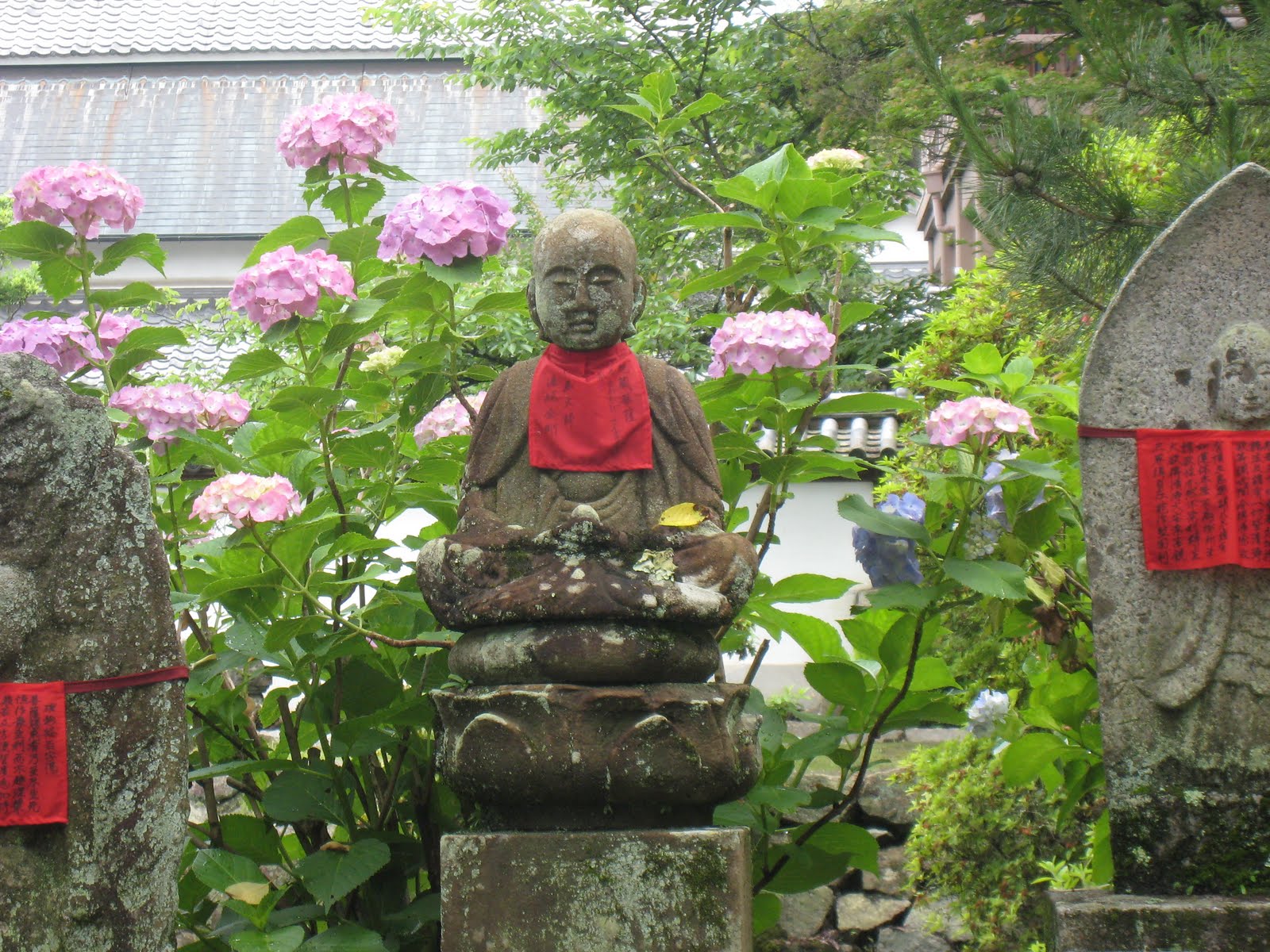
After leaving our car, We had  to climb up a lot of staircase to the temple and we prayed " Jizo- Bosatu"at a main temple. This temple is dedicated to Jizo- Bodhissattva. Many jizo statues( Ojizosama) were placed in the temple.

many Ojizosama are placed inside temple


Ojizosama stand on the edge of cyozu-bachi  beside corridor


Hydrangea HydrangeaHydrangea


What color  are you turning with light and water together from babypink?


People admires splendor and stops to take photos. We can't go ahead soon because of narrow rainy path.  But nobody complain. Everyone are willing to wait.  Flowers make us gently.


We call here Valley of hydrangea. Beautiful hydrangea were filled over the wall of valley.


This temple joins "Yamato 13 Buddh Sacred Places" ,which  means a group of 13 temples in Nara prefecture that enshrines Buddha or Bodhisattva etc. The association of 13 temples suggests to pray those Buddhas to respect our ancestors or fulfill our wishes and give a mount that we get a vermail seal as proof of visiting.  So we got  vermeil seal of this temple and will visit the other 12 temples. But when will we finish to visit all? Because we started visiting of "Shikoku 88 Pilgrimage" (  88 temples in Shikoku where are sacred place of Kobo-Daisi) 8 years ago but we don't finish visiting all, though we visited  about one third.


We had "Shojin Ryori"(cooking used vegitables not meat, fish etc) called "Ajisai Gozen"( Ajisai means hydrangea and gozen means cooking) for lunch inside the temple. It's a usual Shojin Ryori like Tenpura of vegetable ,Gomadofu,Takenoko boiled and seasoned etc. Foe me, Fu (a breadlike food made of wheat) boiled down in sweetened soy tasted good.


Ajisai-gozen


Thank you for marvelous color!


Jikoin Temple

On the way back home, we dropped at Jikoin Temple. It's very near Yata Temple.  When I entered into the entrance, even I felt  beauty of this temple's simpleness, plain, neatness and it didn't seem to be usual temple.

Garden from a drawing room.  A well-kept garden


This garden borrows a view of Yamato plain behind. I think there were not buildings behind before. We had a cup of tea  and sweets  in the shape of heraldry of the Katagiri  on the red carpet . A cool wind came from Yamato plain to us. Very comfortable. Moon Viewing is hold here on the night of the harvest moon of Autumn.
 According to a guide paper, Sekishu Katagiri( feudal lord of this area) built it for family temple in 16 century. He engaged a high priest of Daitokuji Temple in Kyoto as a ahead of the family temple. He received Zen Buddism and Tea Ceremony from the priest and put his "Beauty of Wabi" theory into practice.

So this temple had taste of tea ceremony, such as approach from entrance, garden, tea room, gate etc.
That is to say, my first impression  that this temple is neat was correct, though everyone can feel it.


Temple Gate . It's thatched roof.

Approach from the outside gate. The stony road was spattered with water or rain. I felt it water to entertain guests.